Monday – Friday
- 6:15 AMChaplet of Divine Mercy
- 6:30 AMHoly Mass
Nossa Senhora da Vida — the parish that holds the Holy Cross of the 1653 oath, in the Latin Catholic Diocese of Cochin.
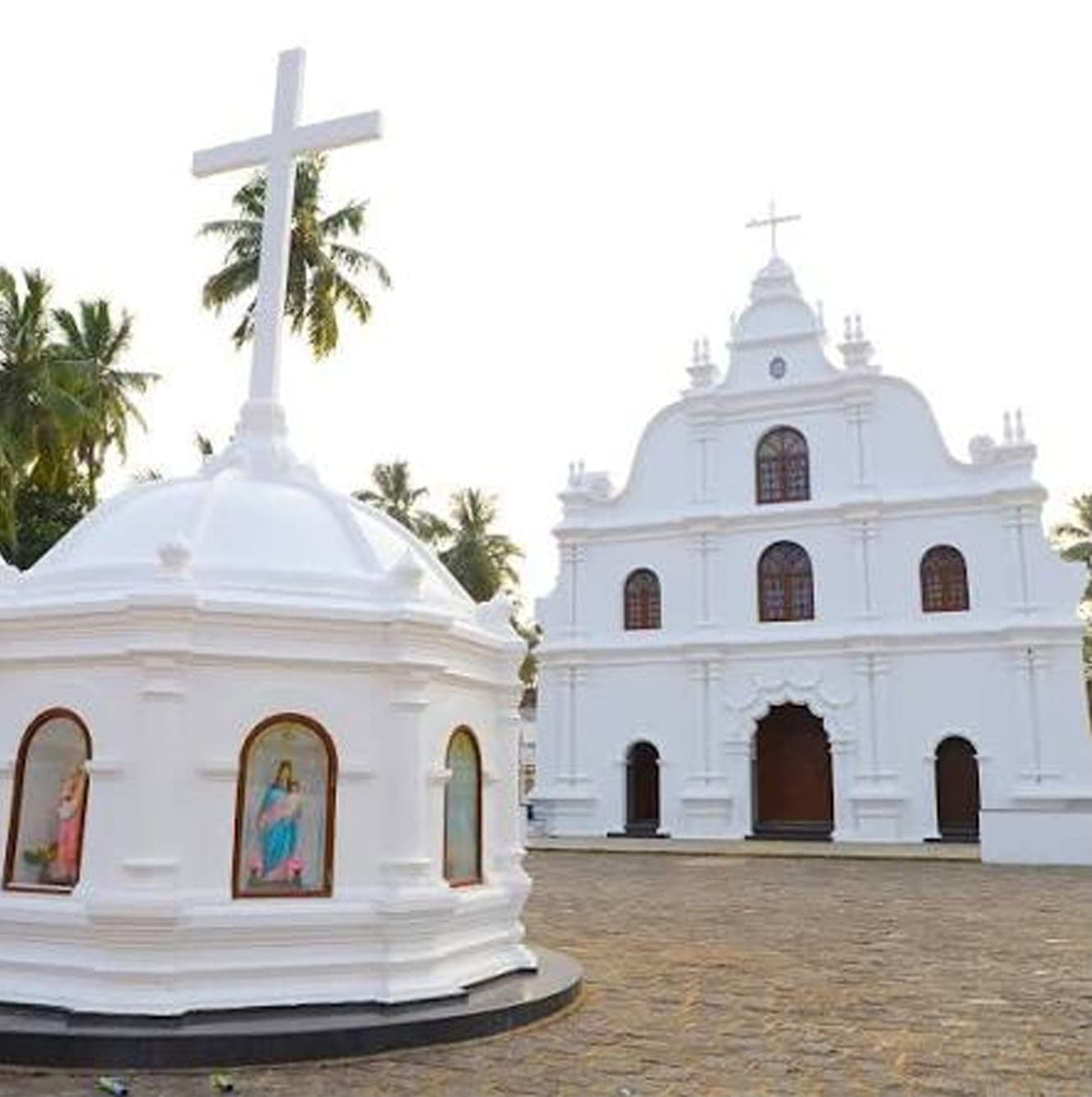
The mother parish of Mattanchery, in the Latin Catholic Diocese of Cochin, guarding the Holy Cross and the memory of the 1653 oath.
The shrine of the Holy Cross — Kuriyachan — stands in the courtyard of the parish church, where pilgrims have gathered since 1550. The parish keeps its own round of liturgies alongside the services of the pilgrim centre.
The parish's own round of holy services at Our Lady of Life Church, Mattanchery.
The roll of vicars of Our Lady of Life Church, from 1879 onward.
From the history of the parish, Our Lady of Life Church, Mattanchery. The year is the year the priest took charge.
From the trade that first brought the Gospel to this coast, through the oath of 1653, to the blessing of the renovated church in 2017.
Rome, Greece, Egypt, Israel, Phoenicia, Babylon and other kingdoms open trade with India, and with Kerala in particular.
At the Lord's bidding, King Solomon gathers cedar, blackwood, spices, apes and the like from Kerala.
The Nestorian heresy begins in Constantinople.
The first Mattanchery church is founded beside the cross Mathan had planted, in the name of the Blessed Virgin Mary. Mattanchery, Edakochi and Manassery were the chief Christian centres of the time. The first Mattanchery church was thatched with palm leaf. The church founded at Edakochi in the same period was in the name of the Magi. The Mattanchery church was known as the Thoma church.
Vasco da Gama lands at Kozhikode.
A company of 13 ships and 18 Franciscan priests under the Portuguese captain Álvares Cabral reaches Kochi. Cabral, who found favour with the King of Kochi, obtained permission to preach the Gospel in Kochi and the surrounding country.
Vasco da Gama reaches Kochi.
The Portuguese begin their efforts to lead the Christians of Kerala, who were then in the Nestorian heresy, into the true Church under the authority of the Pope.
One section of the Mar Thoma Christians resisted the Portuguese effort to free the Christians from the Nestorian heresy and lead them into the true faith under the Pope. The Mattanchery church had two altars, and the sacred rites were celebrated on them by turns in Latin and in Syriac. For this reason the Mattanchery church was also known as the church of two rites.
St Francis Xavier reaches Goa, and afterwards Kochi by way of Kottar. Up to his last visit to Kochi on 24 January 1552 — he died in China on 3 December 1552 — the saint had come to Kochi 53 times. Whenever he was in Kochi he stayed in the building next to the Vasco da Gama church, and the room he used can still be seen there.
The cross chapel is founded at Mattanchery.
The members of the Mattanchery Thoma church become members of the Latin Church in full. The Portuguese then pulled down the existing Thoma church and built a new one; four Franciscan priests led the work. The second Mattanchery church was given the name Mother of Life.
The Diocese of Cochin — spoken of as the cradle of the Catholic Church — is established. It was the second diocese in India after Goa, reaching from Kannur to Kanyakumari and from Ceylon to Burma. (Kollam had been proclaimed the first Latin diocese in India in 1329, but as no bishop took charge the diocese never came into being.)
The place name Jewish Quarter comes into being at Mattanchery. In 1568 the synagogue of the White Jews was established at Mattanchery.
The priests of the Mattanchery Jeevamatha church and the Latin choir take part in the reception given to Aleixo de Menezes, Archbishop of Goa, at the Kochi fort.
The Synod of Udayamperoor, famous in history, runs until 26 June. 813 delegates took part, among them 113 priests and 660 parish representatives. The priests and representatives of the Mattanchery parish and the Latin choir took part throughout. It was Aleixo de Menezes, Archbishop of Goa, who convened the synod. Its aim was to sweep away for good the Hindu customs, the superstitions and the Nestorian tie that had grown up among the Christians. This synod set the course for social change in Kerala.
On Archbishop Aleixo de Menezes's journey back to Goa after the synod, two captains of the Mattanchery church accompanied him as far as Goa.
Ahatalla, who had reached Mylapore with the false claim that the Pope himself had appointed him Patriarch of India and China, was not allowed by the Portuguese to travel on to Kerala. Archdeacon Thomas, who was at odds with the Catholic Church and with the Portuguese authorities, put it about that the Portuguese were holding Ahatalla back. When the attempt to bring Ahatalla to Kerala failed, Archdeacon Thomas spread the further falsehood that a ship carrying Ahatalla had reached Kochi. Some 20,000 Syriac Christians thereupon came to Mattanchery on 24 December 1652 and waited eight days, and then went back. At this point Archdeacon Thomas gave out that the Portuguese had drowned Ahatalla in the backwaters. The enraged crowd pressed into the nearby church of the Virgin Mother — Senhora da Vida — and, with the Holy Scripture and the altar as their witness, swore that they would have no further tie with Archbishop Garcia or with the priests of the Society of Jesus. Those who could not get inside the church made ready to swear by touching the wooden cross that stood beside it. As the people were too many, they tied a rope to that cross and took their oath holding it. This is the Koonan Kurishu oath famous in history. When they pulled on the rope the wooden cross leaned, and so became the Koonan Kurishu — the bent cross.
Carmelite missionaries sent by Pope Alexander VII reach Kerala under Msgr. Joseph Sebastiani. Fr. Matthew of St Joseph (Matheus) OCD, who had been at mission work in Goa, joined them.
The Carmelite priests did their evangelising work while living at Mattanchery. Since no Carmelite house had yet been built there, and since records show they stayed at Mattanchery, it may be taken that Fr. Matthew of St Joseph lived on the upper floor of the Mattanchery church and carried on the mission from there. It was on that upper floor that he began writing the great work praised to this day as the handbook of botany, Hortus Indicus Malabaricus. It was to escape the wars and disturbances that kept breaking out at Mattanchery that Fr. Matheus came to Chathiath; there too he gave the work to the Dutch governor, won him over, and obtained permission to build churches at Chathiath and Varapuzha.
The Dutch take Kochi. Being Protestants, they destroyed every Catholic church and institution in Kochi. The Mattanchery church too was destroyed.
Because the churches and institutions of the Christians had been destroyed, the Dutch suffered in trade: the Christians grew unwilling to supply them pepper, cardamom and other spices. The Dutch then gave permission to build churches at Mattanchery and Vypin. A temporary church was raised on the very site of the one they had destroyed at Mattanchery, and the sacred rites began again.
That monsoon was as fierce as the monsoon of 1341. It was in this flood — which carried away the Vallarpadam church in a single night — that the Koonan Kurishu was washed away. Some records say instead that the true Koonan Kurishu was destroyed in 1663, when the Dutch took Kochi and levelled the Christian places of worship. In 1769 the cross, by then decayed, was repaired and set up again on the same spot, together with the blessing of the third Mattanchery church. That is the cross venerated to this day.
The third Mattanchery church is blessed. Bishop Antonio de Conceição was then Bishop of Cochin. As the Dutch were in power, he governed the diocese from outside Kochi.
Holding that the Christians were friends of the British, Paliath Achan, the prime minister of Kochi, and Velu Thampi, the Dalawa of Travancore, harassed the Christians without let-up. In December 1808 the move the Dalawa and Paliath Achan made against the British failed. Alleging that the Christians had passed word of it to the British, they began a rampage. Churches, institutions and houses were set on fire; thousands were killed; the Mattanchery church too was given to the flames.
The building of the present Mattanchery church is completed. Rev. Fr. Daniel Avaretty was then vicar. It fell in the time of José Bento Martins Ribeiro, the 29th Bishop of Cochin.
Bishop Joseph Kariyil of the Diocese of Cochin performs the blessing of the renovated fourth church. Vicar Fr. Dominic Aluvaparambil and assistant vicar Fr. Prasad Kandathiparambil led the construction work.
From “Mattanchery Jeevamatha Idavaka — Charithra Naalvazhi”, the chronology printed in the parish history.
Roman Catholic Diocese of Cochin
Our Lady of Life Church, Mattanchery
New Road, Mattanchery, Kochi – 682002